Automating Accounts Payable With AI Invoice Agents
TL;DR
Learn how to automate accounts payable, match line items with purchase orders, and pre-populate QuickBooks without manual input.
The Cost of Manual Accounts Payable
Manually processing supplier invoices is slow, expensive, and highly prone to data entry errors. Accountants must download PDFs, double-check that the line items match the original purchase order (PO), type the values into QuickBooks or Xero, and track down managers for sign-off.
The AP Agent Solution
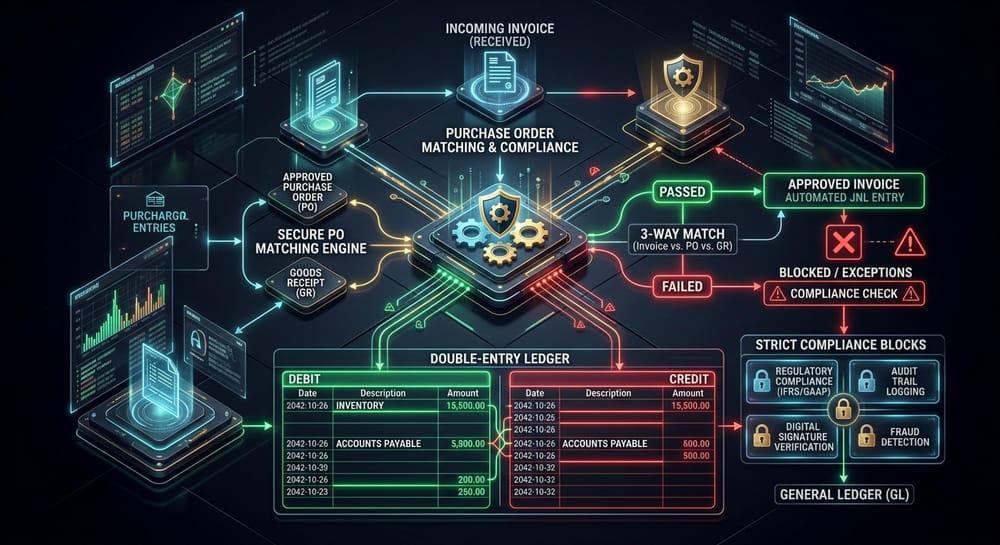
Our AI Invoice Processing Agent automates accounts payable end-to-end:
- Ingestion: The agent automatically extracts invoice PDFs from emails or uploads.
- Optical Character Recognition (OCR) & Extraction: It reads scanned or digital PDFs, extracting the supplier name, invoice date, due date, line items, VAT, and total.
- PO Matching: It queries your CRM or database to verify that the invoice matches an approved PO and that the items were successfully delivered.
- Discrepancy Detection: If a pricing difference or double-billing is detected, it flags the issue for review. Otherwise, it drafts the journal entry directly in QuickBooks.
Safeguarding Financial Operations
Security is paramount in financial automation. The AI agent never has direct wire or bank transfer capabilities. It only prepares draft transactions within your verified accounting portal. A human CFO or accountant must review and sign off on all transactions before actual funds are moved.
The Exceptions That Still Need a Person
A well-built invoice workflow does not aim to eliminate human review. It aims to make sure the review happens on the ten percent of invoices that deserve it rather than on all of them.
Four categories should always surface. A mismatch against the purchase order, whether in quantity, unit price or line item, is the most common and the most expensive to miss. A supplier appearing for the first time deserves a look, because new bank details on an unfamiliar invoice is the oldest payment fraud there is. Anything above your approval threshold goes to whoever holds that authority, unchanged. And any field the extractor scored below your confidence threshold is queued rather than accepted, because a wrong total that nobody questioned costs far more than a short review queue.
Everything else, meaning the recurring invoices from known suppliers that match their purchase orders cleanly, can flow through to the payment run for release.
The measurable outcome is not usually the extraction accuracy, impressive as that number tends to look in a demo. It is the elapsed time from an invoice arriving to being ready for payment, and the proportion of early-payment discounts you actually capture. Both are easy to baseline before you start, and both are visible to a finance lead who has no interest whatsoever in how the parsing works.
Further reading
- SOC 2 — reporting on controls at a service organization — AICPA & CIMA
- AI Risk Management Framework — NIST
Want to discuss these automation patterns?
We custom-program these exact multi-agent systems with absolute human approval gates and strict role security rules.