AI Agents for Customer Support: Clearing Tier-1 Backlogs
TL;DR
See how intelligent customer support agents answer common inquiries instantly, route escalations, and draft support replies.
Resolving Support Bottlenecks
Customer expectations are higher than ever. If a customer has to wait hours for a response to a simple billing or order inquiry, their satisfaction plummets. Yet, scaling support teams to handle peak volumes or weekend inquiries is incredibly costly.
Tier-1 Support Automation
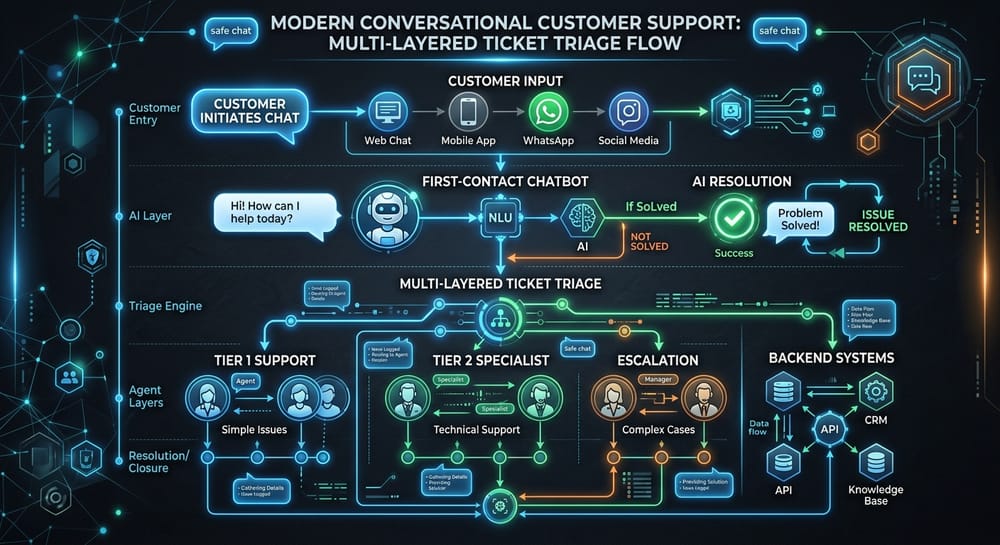
Our AI Customer Support Agent integrates directly with help desks like Zendesk, Intercom, or Salesforce. It works as an active frontline assistant:
- Instant Answers: Resolves up to 70% of standard questions (e.g., shipping statuses, return windows, password resets) in seconds.
- Internal Lookup: It reads your private SOP wiki and knowledge bases, generating precise responses with citations.
- Intelligent Escalation: For complex complaints or technical bugs, the agent categorizes the ticket and drafts a complete reply, leaving it in the queue for human approval.
Driving Business Velocity
By automating routine inquiries, your human support staff can focus on high-value client relations and complex trouble-shooting, reducing burnout and improving CSAT metrics across the board.
Designing the Escalation Path
The part of a support deployment that determines whether customers like it is not the answering. It is the handover.
An escalation should cost the customer nothing. That means the ticket arrives with the conversation, the order or account history and the agent's own reasoning attached, so the person picking it up does not open with "can you explain the problem again?" Handled properly, an escalated ticket is faster to resolve than one that arrived cold, because the context gathering is already done.
It also means escalation has to be easy to reach. A customer who asks for a person should get one, without a loop of clarifying questions first. Trying to deflect that request is where automated support earns its reputation, and it saves far less than it costs.
Define the triggers explicitly before launch. Anything about billing disputes, cancellations, complaints or legal matters should route to a person by default, regardless of how confident the agent is. So should any conversation where the customer's tone has clearly changed, which is a signal the model can detect reliably and which almost never ends well if automated.
The remaining decision is what the agent does while it waits. Telling a customer that a colleague will pick this up, and roughly when, is worth more than a fast wrong answer, and it is the easiest part of the whole system to get right.
Further reading
- AI Risk Management Framework — NIST
- Cybersecurity Framework — NIST
Want to discuss these automation patterns?
We custom-program these exact multi-agent systems with absolute human approval gates and strict role security rules.