Intelligent Document Processing: Ingesting PDFs with AI
TL;DR
A look at how OCR and LLM parsers extract structured details from contracts, rental leases, and legal filings.
The Dark Data Challenge
Up to 80% of business data is unstructured—locked away inside emails, contracts, scanned PDFs, lease documents, and receipts. Traditional databases cannot read this data, forcing employees to spend thousands of hours copy-pasting files into tracking sheets.
Enter Intelligent Document Processing (IDP)
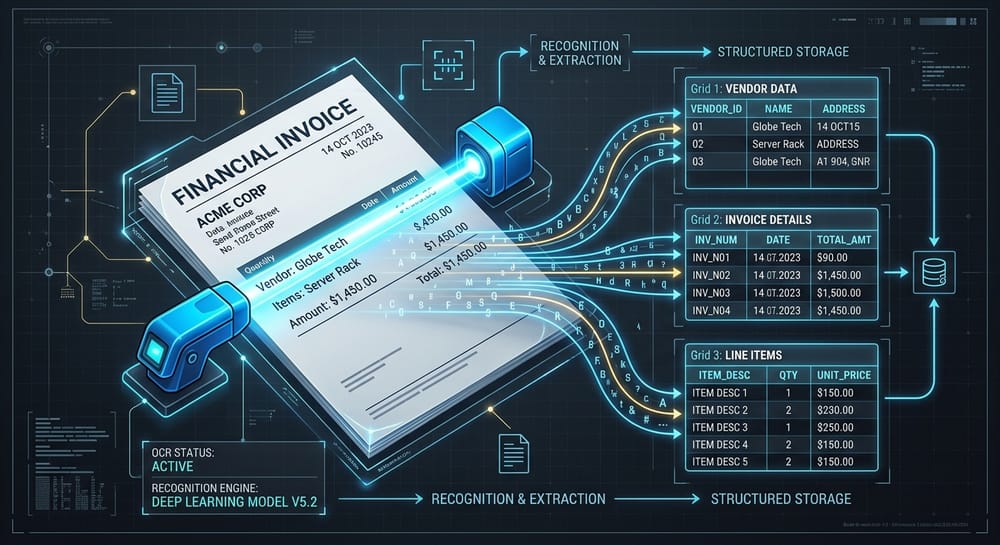
Our AI Document Processing Agent combines advanced OCR with semantic language models to unlock unstructured text:
- OCR Scan: Accurately reads low-resolution scans, rotated documents, or handwriting.
- Semantic Context Mapping: Instead of relying on hardcoded coordinates, the AI reads the document context, identifying "Termination Date" or "Contract Value" wherever they appear.
- Structured Mapping: Translates unstructured text into a clean JSON layout, populating ERPs or databases.
Maximizing Legal and Compliance Speed
A real estate company receiving 200 lease agreements can parse tenant details, rent rates, security deposits, and clause exemptions in under 5 minutes with 99% accuracy, completely eliminating manual copy-paste bottlenecks.
Confidence Scores and Where to Set Them
The single most consequential setting in a document workflow is the confidence threshold, and it is usually chosen carelessly.
The principle is straightforward: set it per field according to what a wrong value costs. An invoice total, a bank account number, a patient identifier and a contract end date all deserve a high threshold, because an error survives for a long time and is expensive to unwind. A description field or a reference note can sit much lower, because a human reading the output will spot a problem immediately and nothing downstream depends on it.
What this produces is a review queue rather than a silent error rate, and that trade is almost always the right one. A queue is visible, it can be staffed, and it shrinks as the extractor is tuned against your real documents. A silent error rate is discovered by a customer.
Two practical notes. Measure on your own documents, not on a vendor benchmark, because the accuracy figure that matters is the one on the layouts your suppliers actually send. And keep the source document linked to every extracted value, so a disputed figure can be traced back in seconds. That link is worth more during an audit than any amount of accuracy on the average case.
Further reading
- AI Risk Management Framework — NIST
- Top 10 for Large Language Model Applications — OWASP Foundation
Want to discuss these automation patterns?
We custom-program these exact multi-agent systems with absolute human approval gates and strict role security rules.