Speed-to-Lead: Using AI Agents for Inbound Sales Follow-Up
TL;DR
Discover why inbound sales leads go cold within minutes, and how AI agents follow up persistently to increase bookings by 45%.
The 5-Minute Inbound Lead Rule
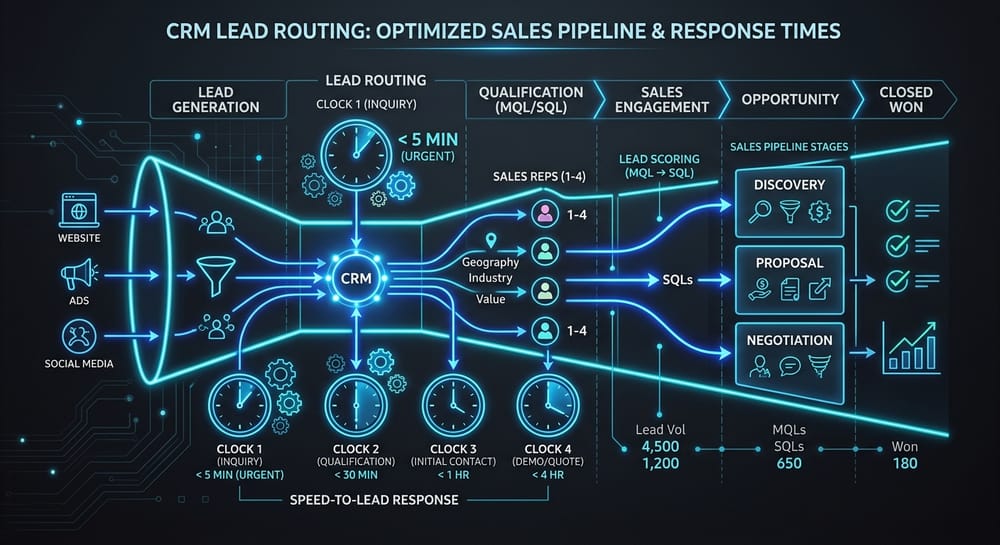
In B2B and consumer sales, "speed-to-lead" is everything. Harvard Business Review studies show that businesses that contact prospects within 5 minutes of lead submission are 100x more likely to qualify the lead than those that wait 30 minutes.
Yet, most sales representatives are in meetings, on calls, or out of the office, letting valuable leads sit warm in queues for hours or days.
The Sales Follow-Up Agent
Our AI Sales Follow-Up Agent monitors inbound lead forms and connects with prospects within 90 seconds. It handles the initial outreach and nurturing loops:
- Immediate Outreach: Sends a customized text and email referencing the user's inquiry details.
- Natural Qualification: Asks qualifying questions (budget, team size, timeline) and answers basic technical specs using your approved manuals.
- Persistent Nurturing: If a prospect stops replying, the agent schedules friendly, natural follow-up notes over the next 14 days.
- Meeting Booking: Guides pre-qualified leads directly to your sales reps' booking calendars.
Freeing Your Sales Team
Your sales reps should spend their time closing deals, not copying emails or chasing cold contacts. Deploying an outreach agent ensures 100% of leads are followed up, maximizing your advertising ROI.
Where Speed-to-Lead Goes Wrong
Responding in two minutes is only an advantage if the response is worth receiving, and this is where most automated follow-up quietly destroys value.
The first failure is volume dressed up as persistence. A sequence that sends eight messages in ten days to someone who downloaded a guide is not persistence, it is a reason to mark the sender as spam, and the damage lands on your domain reputation rather than on the campaign. Cadence, total message count and the point at which the sequence stops should all be set deliberately before anything goes live.
The second is ignoring the reply. Any response that indicates disinterest, including a polite one, has to stop the sequence immediately and be recorded against the contact. An agent that sends message four after someone has said "not right now" is worse than no automation at all, and it is entirely avoidable.
The third is personalisation that is obviously mechanical. Inserting a company name into a template does not read as personal; referencing what the person actually asked about does. If the agent has the enquiry text, the reply should respond to it rather than around it.
Handled with those three constraints, speed-to-lead does what the research says it does. Handled without them, it just gets you to the unsubscribe faster than the competition.
Further reading
- Privacy Framework — NIST
- AI Risk Management Framework — NIST
Want to discuss these automation patterns?
We custom-program these exact multi-agent systems with absolute human approval gates and strict role security rules.