The Best AI Agents for Small Businesses
TL;DR
Learn how small businesses and solo founders are using simple AI agents to eliminate scheduling loops and customer follow-up overhead.
The Small Business Bottleneck
As a small business owner, your biggest asset is your time. Yet, statistics show that small business owners spend up to 40% of their day on administrative tasks—answering general emails, scheduling appointments, logging leads, and chasing invoices.
This admin overhead keeps you from focusing on what actually drives revenue: serving clients and growing your business.
Three High-Impact Agents for Small Businesses
You do not need an enterprise budget to start with AI automation. We recommend starting with one high-impact agent and expanding over time:
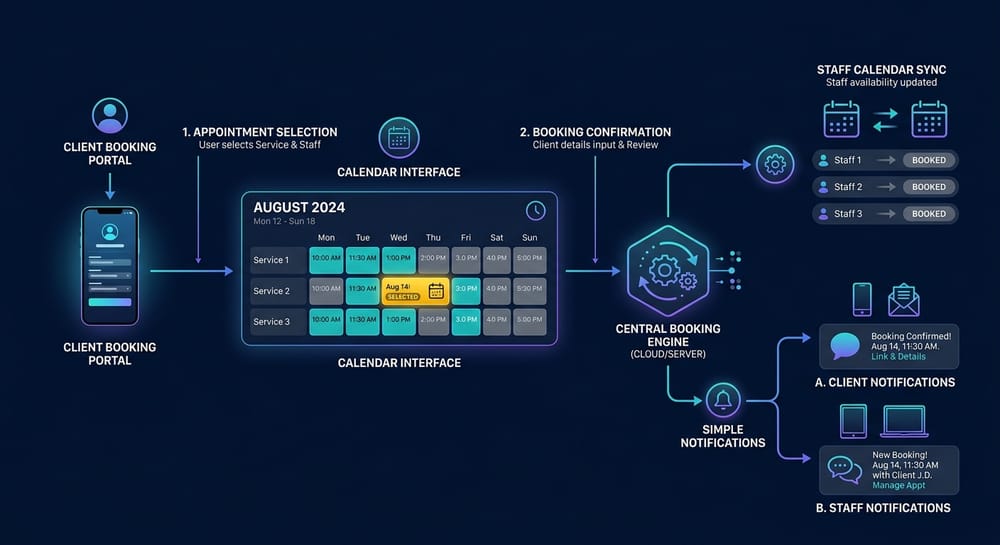
- The AI Calendar Booking Agent: Responds to calendar requests on your website or email in seconds. It negotiates dates in natural language, books your calendar, and sends SMS reminders to prevent costly no-shows.
- The AI Email Routing & Draft Assistant: Connects to your info@ email inbox. It reads messages, answers common questions about rates and hours instantly, and drafts professional replies for complex emails, waiting for your single click to send.
- The AI Lead Capture & Follow-Up Agent: When a potential client submits an inquiry form, this agent replies via text and email within 2 minutes, answers preliminary questions, and books them for a call.
Starting Small, Scaling Intelligently
The secret to successful automation is starting with a single, highly repeatable bottleneck. Once that agent saves you 5-10 hours a week, you can invest those savings back into automating secondary operations like invoice matching or reporting.
Start With One, Not Five
The most common mistake a small business makes here is scope. Five agents sound five times as useful, and in practice they are considerably harder to get right than one, because every integration multiplies the number of things that can quietly break.
Pick the process where three things are true at once. It happens often enough that you can describe a typical week's volume without guessing. The rules are stable, so the same input produces the same right answer. And someone can tell you roughly what it costs today, because without a baseline you will never be able to say whether the automation worked.
For most small businesses that first workflow is booking or inbound email, not because they are the most sophisticated candidates but because they are the highest volume and the easiest to measure. Once one workflow has run for a month, the second choice is much better informed: you will have seen which escalations keep landing on the same person, and that is usually the next thing worth handing over.
The other advantage of starting small is that the cost of being wrong stays small. A single workflow that turns out not to be worth automating is a month and a fixed fee. A five-agent rollout that turns out the same way is a project nobody wants to admit to.
Further reading
- Manage your business — guidance for small businesses — U.S. Small Business Administration
- AI Risk Management Framework — NIST
Want to discuss these automation patterns?
We custom-program these exact multi-agent systems with absolute human approval gates and strict role security rules.