How to Choose the Right Business Workflow for AI Automation
TL;DR
A practical, 4-step framework to identify which internal business tasks will deliver the highest ROI when automated with AI.
Identifying Automation Opportunities
Not all business tasks are suitable for AI automation. Trying to automate a highly creative or strategic task can lead to frustrating results and wasted development capital.
To get the highest ROI, you must identify workflows that are repetitive, structured, and bottlenecked by manual administrative steps.
The 4-Step Evaluation Framework
Use this simple scorecard to evaluate tasks for automation potential:
- High Frequency & Repetition: Is this task performed multiple times a day or week? (e.g., answering booking inquiries, checking receipt details).
- Structured Digital Data: Does the task rely on digital inputs like emails, PDFs, spreadsheets, or CRM profiles?
- Clear Logical Rules: Are there established operational rules for how the task is processed? (e.g., "If the invoice matches the PO, draft the QuickBooks entry").
- Current Bottleneck: Is manual processing of this task slowing down operations or sales cycles?
Designing Your Roadmap
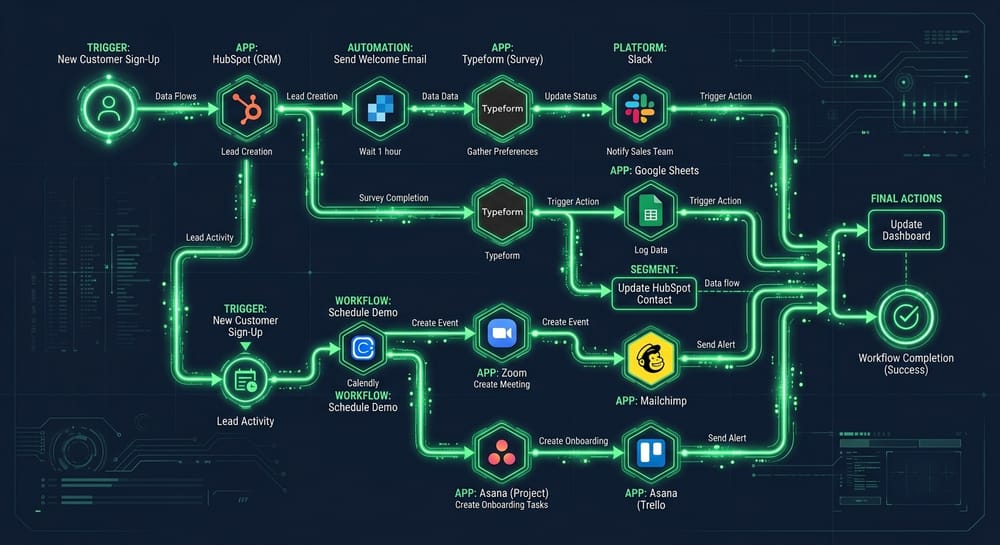
Once you identify a high-score candidate, map its end-to-end steps. Document the input channels, the systems used, and the final output required. This document becomes the baseline blueprint for your first AI prototype.
A Simple Way to Score the Candidates
Most teams can list ten processes they would like automated, and the ranking matters more than the list. Scoring each candidate out of five on four dimensions takes an afternoon and settles most arguments.
Volume. How many times does this happen a month? Below about twenty, the return rarely justifies the build no matter how irritating the task is.
Stability. Would the same input have produced the same correct output six months ago? A process that changes every quarter will need rework every quarter, and that cost belongs in the decision.
Measurability. Can somebody state what this costs today, in hours or in elapsed time? If not, you will have no way to demonstrate the result, and the project will be judged on impressions.
Blast radius. What happens if a case is handled wrongly and nobody notices for a week? High-volume, low-stakes work is the right place to start; a low-volume process where each error is expensive is a poor first candidate even when it is the most annoying one.
Score them, and the first workflow usually picks itself. The one that scores well on volume and stability but poorly on measurability is worth a week of baselining before you commit, which is time much better spent than discovering the gap afterwards.
Further reading
- AI Risk Management Framework — NIST
Want to discuss these automation patterns?
We custom-program these exact multi-agent systems with absolute human approval gates and strict role security rules.