Human-in-the-Loop AI: Why Full Autonomy Is a Risk
TL;DR
An in-depth look at our safety-first engineering philosophy. Why human oversight is critical to successful AI operations.
The Illusion of Perfect Autonomy
With the rise of large language models, some developers advocate for completely autonomous AI agents that run unchecked across company databases. While this sounds exciting, deploying raw, unmonitored AI agents in active business operations is highly risky.
AI models can hallucinate, misunderstood communication tones can alienate customers, and software bugs can trigger duplicate transactions.
Defining "Human-in-the-Loop" (HITL)
At AgenticBizAI, we engineer with Human-in-the-Loop (HITL) architecture. Our agents are designed to do 95% of the heavy administrative lifting—gathering documents, organizing databases, and drafting replies—but they never take sensitive actions without explicit human approval.
- Draft-Only Mode: All emails, contract outlines, and invoice entries are prepared in "draft status" within your existing systems.
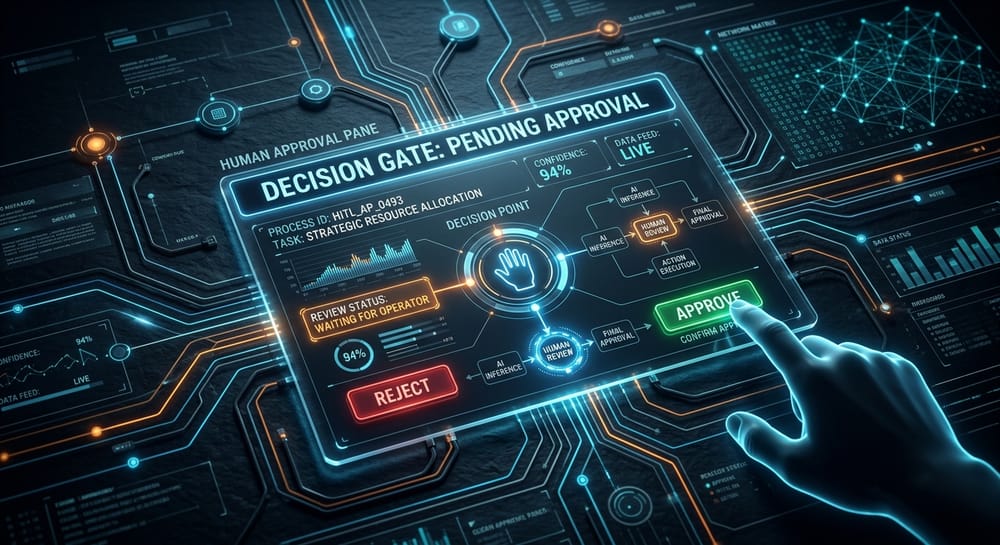
- Approval Gates: The agent displays a card in Slack or your custom dashboard. A human clicks "Approve," "Edit," or "Decline" before any action goes live.
- Confidence Scoring: If an agent's confidence score falls below a set threshold, it immediately stops and escalates the ticket to a human teammate.
Balancing Velocity and Control
This HITL philosophy provides the perfect balance. You gain the speed, consistency, and scale of AI automation, while maintaining absolute control over your customer interactions and company security.
Choosing Which Decisions to Gate
Gating everything is the same as automating nothing, so the useful question is which decisions genuinely need a person and which merely feel as though they do.
Three tests work well in practice. Is the action hard to reverse? Sending money, issuing a credit, signing or committing to an agreement, and deleting records all qualify, because the cost of being wrong is not symmetrical with the cost of a short delay. Is it the first contact with a customer or a counterparty? First impressions are not recoverable, and the volume is low enough that review is cheap. And is it outside the range the agent has already demonstrated it handles reliably? That range comes from the shadow-mode period, which is precisely what that period is for.
Everything failing all three tests is a candidate to run unattended, and should, because a review queue nobody has time to read is a rubber stamp with extra steps.
What makes this work over time is that the boundary moves. Categories that prove reliable over a month can be released; categories where escalations keep turning out to have been correct can be tightened. Treating the gate configuration as something you revisit, rather than something you set once at launch, is the difference between a system that gets better and one that everybody quietly works around.
Further reading
- AI Risk Management Framework — NIST
- Top 10 for Large Language Model Applications — OWASP Foundation
- Cybersecurity Framework — NIST
Want to discuss these automation patterns?
We custom-program these exact multi-agent systems with absolute human approval gates and strict role security rules.