Enterprise-Grade AI Security & Governance
In short
Protect your sensitive customer details, financial records, and proprietary databases with rigorous security protocols.
Security is the number one obstacle holding businesses back from adopting AI automation. We engineer our Agentic AI solutions with a "security-first" architecture. From automatic personally identifiable info (PII) masking to localized private models, role-based database permissions, and encrypted logging, we make sure your business records never leak, and data remains private.
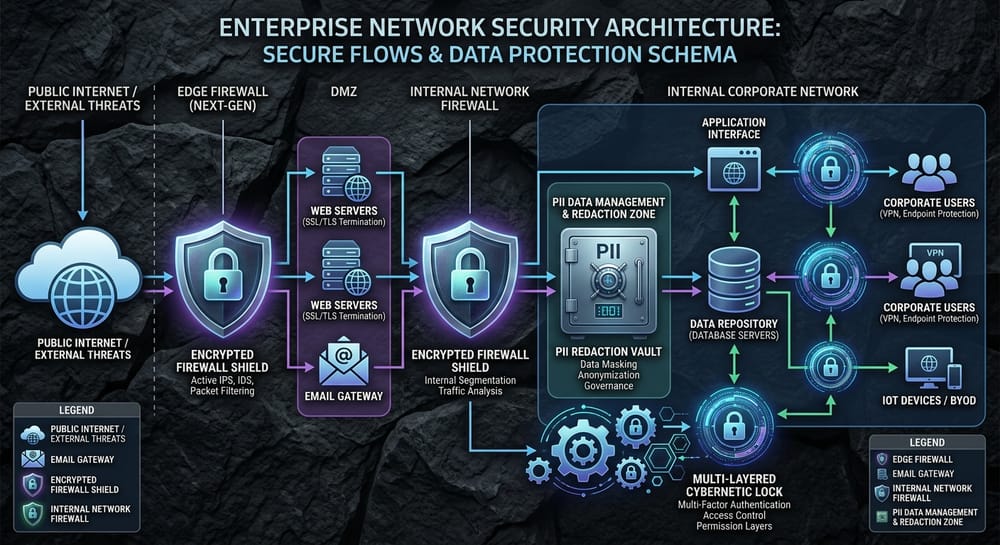
Key Architecture Features
PII Redaction Engine
Automatically scrubs credit cards, tax IDs, and medical parameters before data reaches AI models.
Zero Public Training
Strict data-handling rules ensure your corporate knowledge base is never ingested to train public AI models.
Role-Based Access Control (RBAC)
Integrate existing Okta or Active Directory settings so AI agents only access folders permitted for that user.
Technical System Specifications
- [1]TLS 1.3 encryption in transit and AES-256 encryption at rest
- [2]API keys managed securely in server environment variables
- [3]Complete cryptographic ledger audits of all agent activities
Execution Blueprint
Sensitive Medical Practice Intake
A clinical research clinic uses a patient intake agent to parse lab results. Before sending files to the cloud parser, a secure local Docker agent redacts patient names, SSNs, and phone numbers. It associates them with an anonymous tracking ID, runs the summary, and merges the patient identity back only inside the secure, clinic-hosted server.
Standards and further reading on Enterprise-Grade AI Security & Governance
The architecture above follows published standards rather than our own house rules. These are the primary sources, so you can check the reasoning yourself.
- Top 10 for Large Language Model Applications — OWASP Foundation
- Cybersecurity Framework — NIST
- Cybersecurity best practices — CISA
Common questions about Enterprise-Grade AI Security & Governance
The questions that come up when this sits between your existing systems, answered plainly.
Each deployment runs in its own isolated environment, and we scope exactly which systems and fields an agent may read or write before any build starts. Access is least-privilege, encrypted in transit and at rest, with continuous audit logging.
Untrusted content, such as an inbound email or an uploaded document, is treated as data rather than as instructions, and an agent cannot widen its own permissions at runtime. We design against the failure modes catalogued in the OWASP list for LLM applications linked below.
Yes. An operations lead can disable an agent without filing a ticket or waiting for us, and the workflow stops cleanly rather than leaving half-finished work behind.
Deploy Enterprise-Grade AI Security & Governance in your stack
Book a Free 1-Hour Consultation and get a custom feasibility blueprint built strictly for your stack.