Intelligent Document & PDF Ingestion
In short
Transform dark, unstructured document files into clean, structured databases ready for processing and analysis.
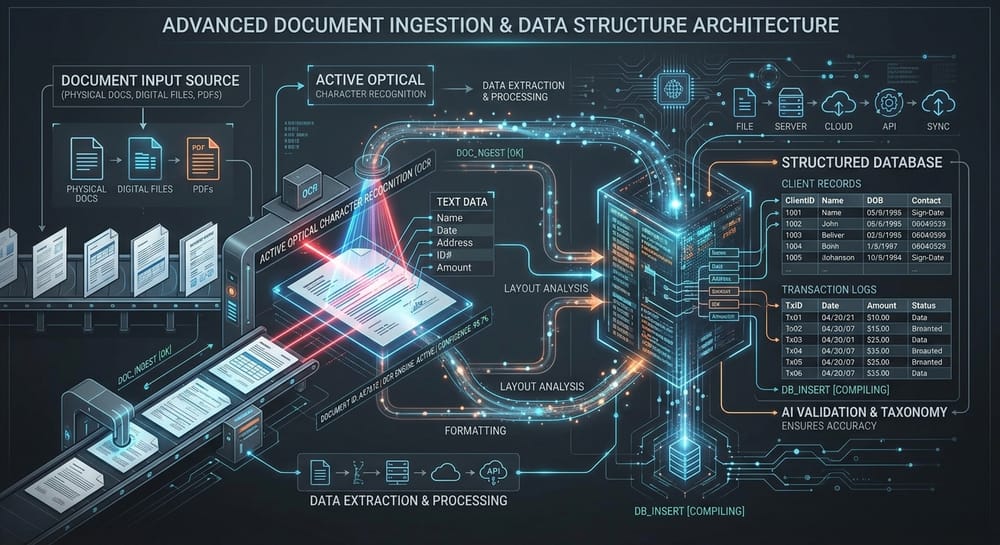
Processing PDFs, scanned image paper, agreements, and spreadsheets manually creates major business delays. Our Intelligent Document & PDF Ingestion solution utilizes advanced optical character recognition (OCR) and semantic document parsing to extract transaction values, legal terms, and patient files, structuring them into a clean relational database.
Key Architecture Features
OCR Hand-off Pipeline
Accurately reads low-resolution scans, handwriting, and rotated document files.
Semantic Schema Matching
The AI understands different invoice and contract styles, mapping varied fields to a single format.
Data Validation Verification
Automated math checks (subtotal + tax = total) flag anomalies before DB entry.
Technical System Specifications
- [1]Integration with cloud OCR services
- [2]Extract structured metadata output mapped directly to JSON schemes
- [3]Supports processing of high-volume ZIP, PDF, TIFF, and DOCX directories
Execution Blueprint
Contract Ingestion and Auditing
An insurance company receives 300 paper policy applications daily. The AI Document Agent scans files, extracts patient history and liability coverage values, flags missing signatures, and updates the compliance portal in real-time, saving 35 hours of weekly manual input.
Standards and further reading on Intelligent Document & PDF Ingestion
The architecture above follows published standards rather than our own house rules. These are the primary sources, so you can check the reasoning yourself.
- Privacy Framework — NIST
- AI Risk Management Framework — NIST
Common questions about Intelligent Document & PDF Ingestion
The questions that come up when this sits between your existing systems, answered plainly.
No, and that is the reason to use this rather than a forms product. The agent extracts the fields you need across layouts that differ by sender, which is what defeats template-based capture in practice.
They are routed for human review with the uncertain fields highlighted, rather than written through at low confidence. You set the threshold, and it can be tightened for the fields where a wrong value is expensive.
Partially, and honestly this is where accuracy drops. Clean digital documents extract reliably; poor scans and handwriting produce lower confidence scores and correspondingly more review. We measure this on your real documents during the blueprint rather than promising a figure up front.
The processing itself is usually live within the same rough 30-day window as any first workflow. The variable is your documents: a handful of consistent senders is quick, while a long tail of unusual layouts takes longer to reach a confidence level worth trusting.
Deploy Intelligent Document & PDF Ingestion in your stack
Book a Free 1-Hour Consultation and get a custom feasibility blueprint built strictly for your stack.