End-to-End Workflow Automation
In short
Connect multiple tools and systems into a single self-executing workflow, driven by intelligent AI agents.
Most business operations aren't limited to a single application. They involve receiving an email, searching a spreadsheet, updating a CRM, generating a PDF, and alerting a teammate on Slack. Our End-to-End Workflow Automation solution joins these fragmented steps into a single cohesive, self-executing line of action managed by cooperative AI agents.
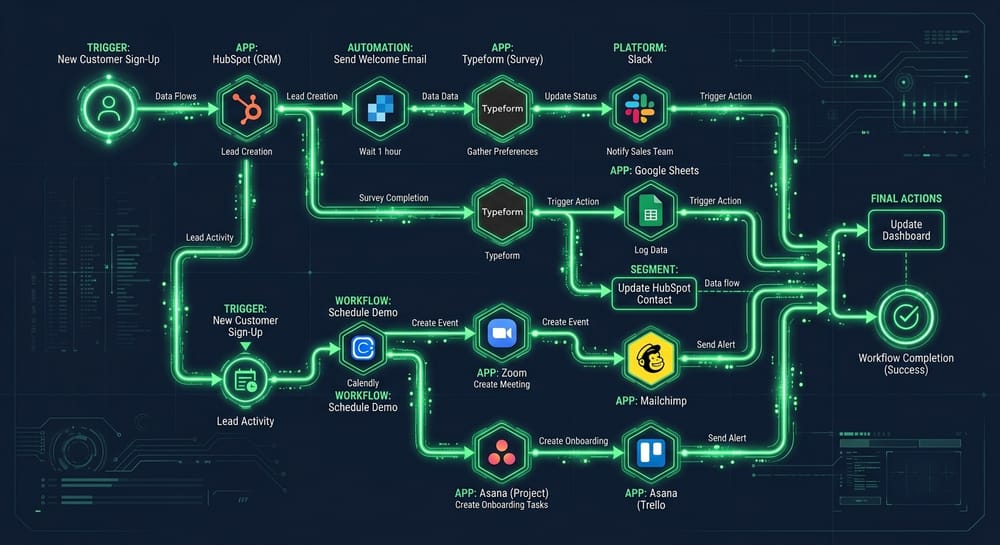
Key Architecture Features
Cross-App Integration
Connects Gmail, Outlook, HubSpot, Salesforce, Stripe, QuickBooks, Google Drive, and custom APIs.
Dynamic Decision Routing
AI agent evaluates incoming email/document content and directs it down the appropriate team path.
State-Aware Orchestration
Maintains context across multi-day business processes, resuming seamlessly when human inputs are given.
Technical System Specifications
- [1]Built with custom Express/Vite orchestrations or specialized frameworks
- [2]Event-driven triggers (Webhooks, WebSockets, API Polling)
- [3]Deterministic fallback logic gates prevent infinite loops and logical dead-ends
Execution Blueprint
Multiphase Client Onboarding
Upon contract signature in DocuSign, our workflow swarm instantly sets up accounts in Stripe, creates client records in Salesforce, provisions a dedicated channel in Slack, generates a customized welcoming pack PDF, and drafts an initial introduction email for the accounts director.
Standards and further reading on End-to-End Workflow Automation
The architecture above follows published standards rather than our own house rules. These are the primary sources, so you can check the reasoning yourself.
- AI Risk Management Framework — NIST
- Cybersecurity Framework — NIST
Common questions about End-to-End Workflow Automation
The questions that come up when this sits between your existing systems, answered plainly.
Rule-based automation follows a fixed script and breaks the moment a step is unstructured or ambiguous. These workflows put an agent at that step, so it can read the message, decide what it means and choose the next action, while the deterministic parts stay deterministic.
The workflow stops at that step and escalates with its state intact, rather than continuing on a bad assumption. Retries, timeouts and the fallback route are defined before it goes live, and every run is recorded end to end.
As many as the process genuinely touches. In practice the first workflow usually covers three or four systems, because that is where the manual copying between them is costing the most time.
Pick the one that is high volume, well understood by the people who run it, and painful enough that somebody can tell you roughly what it costs today. That last part matters: without a baseline measurement there is no way to show what the automation actually returned.
Deploy End-to-End Workflow Automation in your stack
Book a Free 1-Hour Consultation and get a custom feasibility blueprint built strictly for your stack.